Digital geography
Where is an online casino based — and why does it matter?
A map of brand, legal entity and customer market explains why an overseas address or regulator logo cannot answer every licensing question.
Start with three different places
An online casino can present a British-looking brand, name an overseas company in its terms and show several regulatory references in the footer. These details do not necessarily contradict one another. They may describe different parts of the service. The mistake is to compress them into a single question about where the casino is based.
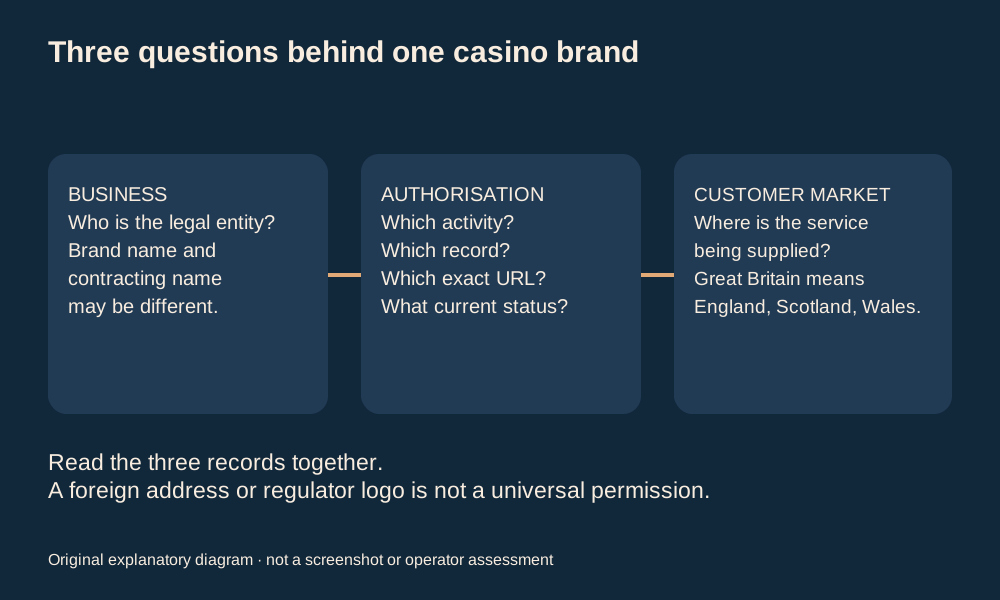
Our map separates three things: the address or identity of the business, the authorisation claimed for a particular activity, and the market in which the customer is being served. It is a reading tool, not a list of recommended jurisdictions. No operator has been assessed or endorsed for this article. The examples are deliberately hypothetical so that a reader can practise matching the right question to the right official record before drawing a conclusion.
For Great Britain, the customer market matters
The Gambling Commission's remote-sector guidance states that providing remote gambling to consumers in Great Britain requires its licence. It expressly applies that requirement to businesses based abroad and gives the example of a Malta-based service used by people in England, Scotland or Wales.
That means a foreign office address does not settle the authorisation question for this audience. Equally, a Union flag, sterling display or .co.uk domain is not itself a licence. Those are elements of presentation or addressing, not substitutes for the regulator's record. This article uses Great Britain precisely: England, Scotland and Wales. It does not extend that regulatory statement to Northern Ireland or assume that every place described casually as the UK has an identical gambling framework.
Sources: Great Britain remote-sector guidance.
Malta: follow the exact URL and entity
The Malta Gaming Authority's register page links to its official Licensee Register and a separate URL Checker. These are routes back to the authority's records, not a reason to trust a badge on another website. The useful reading habit is to compare the exact address being visited with the record, rather than accepting a familiar company name or a copied image of a seal.
The authority's Player Hub also directs readers towards checks on suspicious websites and misleading licensing claims. An apparent badge on a page is therefore a starting point for verification, not the end of it. Our proposed notes record the hostname, legal entity, claimed authorisation and date checked in separate fields. A genuine record for one company or address cannot be assumed to cover a similar spelling, an unrelated mirror or another business using a similar trading name.
Sources: MGA licensee register and URL checker; MGA Player Hub.
Gibraltar: read current categories, not an old reputation
Gibraltar's Gambling Division describes its licensing framework and publishes information for applicants and licence holders. The current Getting Licensed page explains the transition from the 2005 Act to the Gambling Act 2025 and identifies a wider scope of regulated activities. That makes the date and category of a document relevant when reading an international business profile.
For this article, the point is methodological. An old description of a jurisdiction may no longer describe its present licensing categories. A licence relating to a business or supply activity is also a different proposition from a conclusion that a particular customer-facing service is authorised for a particular market. Follow the current official record and the activity it describes. Do not use a historic reputation, a travel photograph or an office address as a shortcut to that work.
Sources: Gibraltar: Getting Licensed.
A brand is not always the contracting name
Our fictional example is Lantern Casino, a name used only in this worksheet. Its imagined footer names Lantern Example Limited; its game screen also shows a separate software studio. A reader who records only Lantern Casino has missed two different roles. The entity named in account terms is a question about the customer relationship. The studio label is a question about the supplied game. Neither should be silently substituted for the other.
In a real investigation, copy the short legal name accurately, follow the official register route and compare the relevant activity and status. If the available information conflicts, retain both versions with their sources instead of selecting the more reassuring one. The aim is not to fill every field quickly. It is to discover whether the pieces refer to the same service at the same time.
What the map cannot tell you
The diagram deliberately leaves out several tempting shortcuts. It does not rank jurisdictions as safest, predict withdrawal speed or certify the treatment of a complaint. It does not infer server location from the business address, and it does not infer a licence from the place suggested by a brand name. Those are separate questions requiring their own evidence.
Likewise, an active licence is not a guarantee of a profitable game or a particular customer experience. The correct result of a narrow register check is a narrow statement about the record that was found. A fuller review would need current terms, the exact service, the customer's market and the relevant complaint route. The Night Atlas approach is to make geography more precise, not to turn a map into a substitute for those documents.
Build a record before forming an opinion
The offline worksheet asks which part of a claim you are examining: the brand, the legal entity, the regulatory claim or the customer market. Selecting one reveals the next piece of evidence to seek. It performs no live register lookup and never pronounces a casino licensed. You should not enter account numbers, personal details or passwords.
For your own notes, keep a date alongside the source and write the unresolved question in full. “The footer names this company; I have not yet matched this exact website to the relevant register entry” is a useful intermediate finding. “Seems regulated” is not. When a record has a status or activity field, retain that detail. A cropped image of a logo cannot communicate the scope or time of an authorisation.
This is an offline reading guide. It does not check an operator or establish that a service is licensed.
Cross-border does not mean interchangeable
A useful international casino guide distinguishes a city, a company domicile and a consumer market. It also acknowledges that physical travel and remote access are different activities. Reading about a casino building in Monaco does not establish which online services a person in Britain may use. This article provides no method for bypassing geographic restrictions or accessing a service that does not accept the relevant market.
The practical sequence is to identify the exact service, identify the customer market and consult the appropriate current official records. Malta and Gibraltar are included because their authorities provide distinct regulatory information, not because either name supplies a universal permission. Once those roles are separated, an international footer becomes easier to read: several addresses may be meaningful, but each one has to answer the question it actually belongs to.
Questions answered
Is an overseas gambling licence enough to serve Great Britain?
The Gambling Commission says remote gambling supplied to consumers in Great Britain needs its licence, including where the business is based abroad. An overseas licence alone does not answer that market-specific question.
Does a .co.uk address prove a casino is licensed?
No. A domain suffix or a regulator image is not a substitute for the relevant official record. Match the exact service, entity, activity, market and current status.
Does this article cover Northern Ireland’s gambling rules?
No. Its British regulatory statements refer to Great Britain: England, Scotland and Wales. It does not assume that Northern Ireland has an identical framework.