Facts checked Article
Casino destinations
A casino regulator and a dispute adjudicator have different jobs
Map an account complaint across Great Britain and Malta by separating the operator, the adjudicator and the regulator, with a fictional two-issue case.
Begin with the account’s applicable route
A regulator’s name in a casino footer does not mean that regulator will decide an individual disputed payment. The Gambling Commission says it does not resolve complaints about gambling-related transactions. Malta’s framework also separates regulatory complaints from disputes over the merits of an individual case, directing the latter towards the relevant alternative dispute resolution entity.
The useful comparison is therefore not simply Britain versus Malta. It is operator, adjudicator and regulator within the framework that actually governs the account. A person may have a financial dispute and information about a possible regulatory breach at the same time.
Those issues can require different routes even when they arise from one incident.
This article compares published Great Britain and Malta guidance. It does not establish which licence governs a named account, decide a legal claim or promise a recovery. Curaçao is outside the verified comparison: its complaints policy PDF could not be retrieved during this research.
The map below has two evidenced jurisdictions, rather than a third column filled from search snippets or assumptions.
Sources: Complain about a gambling business; MGA Publishes Alternative Dispute Resolution (ADR) Directive.
Bearings: two frameworks, three roles
- Great Britain: who decides
- The Gambling Commission says it does not resolve complaints about gambling-related transactions; its complaints page directs customers to complain to the business first.Complain about a gambling business · as checked on
- Great Britain: the ADR clock
- The Commission’s ADR guidance says the business should have up to eight weeks to resolve a complaint; a customer still dissatisfied can then take it to an ADR provider, described as a free, independent service.Taking your complaint to an Alternative Dispute Resolution (ADR) provider · as checked on
- Malta: the split since 1 April 2019
- The MGA’s Player Support Unit no longer examines the merits of disputes between players and B2C licensees; that function is reserved for the relevant ADR entity.MGA Publishes Alternative Dispute Resolution (ADR) Directive · as checked on
- Malta: the operator’s duty
- The MGA’s player-protection page requires operators to publish a complaints procedure and identify the ADR entity available after the internal dispute process is exhausted.Player Protection · as checked on
- Malta: the complaint form
- The public complaint form strongly recommends first seeking a resolution with the operator’s support and management, and says identification may be requested.Lodge a Complaint · as checked on
Published Great Britain and Malta guidance. Nothing here establishes which licence governs a named account, decides a legal claim or promises a recovery.
Great Britain starts with the gambling business
The Commission’s public complaints page directs customers to complain to the business first. It lists a broad range of possible subjects, including results, amounts paid, payment management, terms, verification, account closure and customer service. Being on that list does not mean every subject will later fall within an adjudicator’s remit.
The distinction is easy to lose when an account page displays several contact links together. A general support channel, a formal complaints process and a regulator’s reporting route may all be visible. Their proximity on a page does not give them the same power.
Read the operator’s complaint procedure for the route it actually names, and retain its response with the original issue.
A useful private record states the question being disputed and the remedy requested. “I disagree with the settlement of this transaction” is different from “I want to report how the company handled complaints”. Neither sentence needs speculation about the operator’s motives.
The first identifies a potential individual dispute; the second describes information that may be relevant to supervision.
This is a route map, not a licence-checking tutorial. The contracting entity and applicable terms need to be established before applying the comparison to an account. A group’s overseas office does not itself answer that question.
Sources: Complain about a gambling business.
The British ADR route has its own scope
The Commission’s ADR guidance says the business should have up to eight weeks to resolve a complaint. If the customer remains dissatisfied after that period, the complaint can be taken to an ADR provider. It describes ADR as a free, independent service and explains that the operator should identify its provider.
The guidance also discusses a deadlock letter issued when the business concludes its complaints process.
An ADR provider first decides whether it can adjudicate the complaint. The Commission’s page says customer-service issues and refusal to accept a bet or a person’s custom are outside that route. A reader should therefore resist treating “complaint” as a universal admission ticket.
For our mapping method, record three separate fields: the date the complaint was raised, the operator’s stated conclusion or current position, and the named provider’s acceptance decision. An elapsed period is not the same as an award, and acknowledgement is not acceptance of the merits. Those distinctions matter even when every communication is polite and prompt.
The source also describes possible appeals and other resolution options. This article does not advise a particular court claim or compare litigation costs. Its purpose is to stop the regulatory address being mistaken for the destination that decides an individual transaction dispute.
Sources: Taking your complaint to an Alternative Dispute Resolution (ADR) provider.
Great Britain: three fields to record
An elapsed period is not the same as an award, and acknowledgement is not acceptance of the merits. Customer-service issues and refusal to accept a bet or a person’s custom are outside the ADR route.
Ticks are kept only in this browser and are never sent anywhere.
Malta distinguishes a complaint from a dispute
The MGA’s ADR announcement explains that, from 1 April 2019, its Player Support Unit would no longer examine the merits of disputes between players and B2C licensees. That function was reserved for the relevant ADR entity. The announcement separately describes complaints about services alleged to be unlawful, unsafe, unfair or insufficiently transparent.
It also explains what happens when the same submission contains both elements: the Player Support Unit examines the regulatory complaint independently of the ADR entity. This is why an MGA complaint form should not be interpreted as a promise that the authority will determine how much an operator owes a player.
The distinction can be expressed without legal shorthand. One question asks, “What should happen to my particular disputed transaction?” Another asks, “Does this conduct indicate a failure in the licensed service?” They may share documents, but they ask different institutions to perform different jobs.
The announcement is a dated explanation of the institutional split. We read it alongside the MGA’s current player-protection page and complaint form, rather than assuming a historic news item supplies every present procedural detail. An account-specific deadline, admissibility condition or requested document still needs the current procedure that applies to that case.
Sources: MGA Publishes Alternative Dispute Resolution (ADR) Directive.
Read the current MGA procedure beside the form
The MGA’s player-protection page requires operators to publish a complaints procedure and identify the ADR entity available after their internal dispute process is exhausted. It describes ADR conclusions as binding on both parties while preserving the player’s ability to bring proceedings before a competent court.
The page does not give this comparison a universal Malta equivalent of the British eight-week statement.
The public complaint form strongly recommends first seeking a resolution with the operator’s support and management. It also says identification may be requested. At retrieval the page carried a notice about intermittent technical issues with the form.
That is a dated observation about the page; it is not proof that a particular attempted submission succeeded or failed.
For a private complaint, use the authority’s official instructions and avoid placing identification or account records in public comments. For an editorial comparison, record the form’s function and its stated limitations without submitting a test complaint. We have not sent information to either authority.
This creates a useful evidence pairing. The form shows a channel for reporting to the authority. The ADR guidance explains why that channel is not interchangeable with adjudication of a monetary dispute.
Reading only one of them leaves an incomplete map.
Sources: Player Protection; Lodge a Complaint.
Malta: reading the form beside the procedure
We have not sent information to either authority. The form shows a channel for reporting to the authority; the ADR guidance explains why that channel is not interchangeable with adjudication of a monetary dispute.
Ticks are kept only in this browser and are never sent anywhere.
Compare the routes without ranking jurisdictions
For Great Britain, the first destination is the business’s complaint process. The external transaction-dispute route is the appropriate ADR provider, subject to its remit and the published escalation conditions. The Commission’s public guidance explicitly separates itself from deciding gambling-related transaction complaints.
For the MGA framework, the first destination is likewise the operator’s internal process. A dispute can then go to the relevant ADR entity. A regulatory complaint goes to the authority’s Player Support Unit, whose supervisory role remains distinct from determining the merits of the individual dispute.
Those are two rows of a functional comparison, not a league table. They tell the reader which role to look for. They do not measure success rates, typical response times, ease of enforcement or the likelihood of recovering a balance.
None of those outcomes was researched or tested here.
The original figure draws the common operator-to-ADR route alongside a separate regulatory-report branch. It is schematic: the relevant provider, scope and conditions still belong to the applicable jurisdiction and account. A shared shape does not establish identical rules.
In particular, do not copy a timeframe from the British guidance into a Malta complaint because both systems use the initials ADR.
| Framework | First route | Individual dispute | Regulatory role |
|---|---|---|---|
| Great Britain | Business complaint process | Appropriate ADR provider, subject to remit | Commission does not decide transaction complaints |
| MGA | Operator internal process | Relevant ADR entity | Player Support Unit examines regulatory complaints |
Sources: Complain about a gambling business; Taking your complaint to an Alternative Dispute Resolution (ADR) provider; Player Protection; MGA Publishes Alternative Dispute Resolution (ADR) Directive.
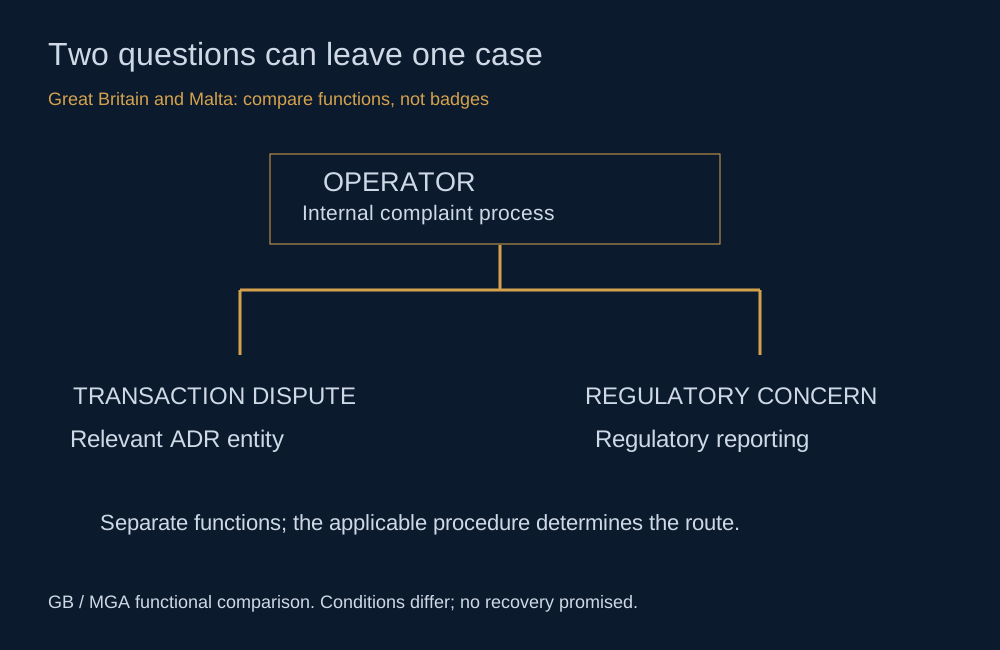
A fictional complaint with two different questions
Suppose an adult customer disputes an invented £120 settlement and also says the operator gave contradictory instructions about its complaints procedure. The amount is illustrative; it is not a real case, a compensation estimate or a threshold in either system.
Separate the file into two questions. The transaction question is why the £120 was settled as it was and what correction is requested. The process question is which instructions were inconsistent and when they were supplied.
Keep the same underlying messages available, but do not assume that sending the process concern to a regulator automatically transfers the transaction dispute to an adjudicator.
Under the British row, the customer begins with the business and follows the relevant ADR route when its conditions are met. Under the MGA row, the merits of the dispute belong with the relevant ADR entity after the internal process, while a regulatory concern can be examined separately by the authority.
The exercise changes the destination and purpose of the file; it does not decide who is right.
How to map a two-question complaint file
The repeatable method from the fictional case. The £120 is illustrative, not a real case, a compensation estimate or a threshold in either system.
Separate the file into two questions
The transaction question is why the £120 was settled as it was and what correction is requested. The process question is which instructions were inconsistent and when they were supplied.
Map each question to a function
Under the British row, the customer begins with the business and follows the relevant ADR route when its conditions are met. Under the MGA row, the merits belong with the relevant ADR entity after the internal process, while a regulatory concern can be examined separately by the authority.
Attach the applicable procedure
Keep the same underlying messages available, but do not assume that sending the process concern to a regulator transfers the transaction dispute to an adjudicator.
Mark the last confirmed event
Without the operator’s final response, the internal process cannot honestly be labelled exhausted. A receipt from an external body does not establish jurisdiction, acceptance or an outcome.
What the result means
The exercise changes the destination and purpose of the file; it does not decide who is right. A licence jurisdiction tells you where to look for the governing framework, not that every contact address in it substitutes for every other one.
The fictional file, revisited: what a receipt does not establish
Now remove the operator’s final response from the fictional file. The gap becomes obvious. A reader cannot honestly label the internal process exhausted without evidence of its position and applicable procedure.
Add a receipt from an external body instead, and another distinction appears: receipt does not establish jurisdiction, acceptance or an outcome.
The repeatable method is to map each question to a function, attach the applicable procedure and mark the last confirmed event. This keeps the geography useful. A licence jurisdiction tells the reader where to look for the governing framework; it does not make every contact address in that jurisdiction a substitute for every other one.
Terms on the map
- ADR
- Alternative dispute resolution: an independent body that adjudicates an individual dispute between a customer and a business, within its stated remit.
- B2C licensee
- A business-to-consumer licensee, one that serves players directly rather than supplying other businesses.
- Player Support Unit
- The MGA unit that examines regulatory complaints; since 2019 it does not examine the merits of player disputes.
- Deadlock letter
- A letter a business issues when it concludes its complaints process; the Commission’s guidance discusses it as a step before ADR.
- Remit
- The range of subjects an ADR provider will adjudicate; the provider decides that question first.
- Regulatory complaint
- A report that a licensed service may be unlawful, unsafe, unfair or insufficiently transparent, examined by the authority rather than by an adjudicator.
Questions answered
Will the Gambling Commission decide my casino payment dispute?
Its public guidance says it does not resolve or decide complaints about gambling-related transactions. Start with the business’s complaints process and identify the appropriate external dispute route.
When can I take a British gambling complaint to ADR?
The Commission’s guidance describes escalation after eight weeks if unresolved and discusses deadlock letters when the business concludes its process. The provider still decides whether the subject falls within its remit.
Does the MGA complaint form replace ADR?
No. The MGA distinguishes regulatory complaints from the merits of player disputes. The latter belong with the relevant ADR entity, while the authority can examine a regulatory complaint separately.
Can the same incident contain a dispute and a regulatory complaint?
Yes. The MGA’s published explanation expressly addresses that combination. Keep the requested individual remedy separate from the concern about compliance.
Is there a verified Curaçao complaints comparison here?
No. The policy PDF could not be retrieved during this research, so its detailed route, deadlines and conditions are not asserted. The evidenced comparison is limited to Great Britain and Malta.
What subjects does the Commission’s complaints page cover?
It lists results, amounts paid, payment management, terms, verification, account closure and customer service. A subject on that list may still fall outside an adjudicator’s remit.
Does an ADR decision in Malta stop me going to court?
No. The MGA’s page says ADR conclusions bind both parties. The player can still bring proceedings before a competent court.
Is the £120 in the example a real threshold?
No. The amount is illustrative. It is not a real case, a compensation estimate or a threshold in either system.
Market sources
Continue reading
How does a UKGC licence protect players?: what it means for a UK player, regulator by regulator
The protections a Great Britain licence gives a player are written in the Licence Conditions and Codes of Practice: an eight-week complaints clock, a free dispute body, a stated level of protection for deposited money and a self-exclusion register. This log lists each one against the regulator's own page, and states what a UK reader is left with when the account sits outside that regime.
Read How does a UKGC licence protect players?: what it means for a UK player, regulator by regulator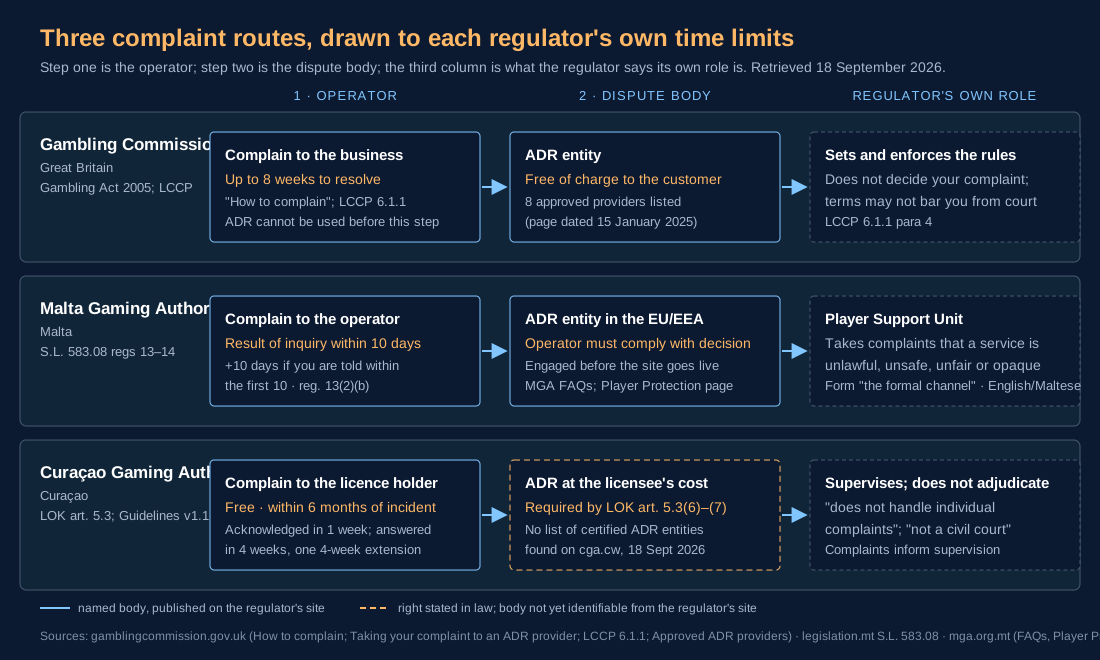
What a Curaçao licence means for a UK player: complaints, balances and whether the site may serve you at all
Three regulators publish three different promises. This page puts the Gambling Commission, the Malta Gaming Authority and the Curaçao Gaming Authority side by side on complaints, dispute bodies, player funds and advertising, quoting each regulator's own page as it read on 18 September 2026, and it starts with the British rule that decides whether a site may take a player in Great Britain at all.
Read What a Curaçao licence means for a UK player: complaints, balances and whether the site may serve you at all
Grand Lisboa: a casino in the shape of a landmark
A 40-storey lotus tower over a podium that holds the casino. Two first-party sources describe it, and neither of them changes what a UK player is owed.
Read Grand Lisboa: a casino in the shape of a landmark
Baden-Baden’s casino and the conversation house
The Kurhaus places casino rooms inside a longer history of strolling, music and social exchange.
Read Baden-Baden’s casino and the conversation house
Inside the Casino de Monte-Carlo’s theatrical history
The Salle Garnier places performance at the heart of a familiar casino-city image.
Read Inside the Casino de Monte-Carlo’s theatrical history
When an online casino closes, the balance follows the account's legal arrangements
Separate a planned casino closure from insolvency, identify customer funds, and compare what the UKGC and MGA actually say about balance protection.
Read When an online casino closes, the balance follows the account's legal arrangements
Continue reading
How does a UKGC licence protect players?: what it means for a UK player, regulator by regulator
The protections a Great Britain licence gives a player are written in the Licence Conditions and Codes of Practice: an eight-week complaints clock, a free dispute body, a stated level of protection for deposited money and a self-exclusion register. This log lists each one against the regulator's own page, and states what a UK reader is left with when the account sits outside that regime.
Read How does a UKGC licence protect players?: what it means for a UK player, regulator by regulatorWhat a Curaçao licence means for a UK player: complaints, balances and whether the site may serve you at all
Three regulators publish three different promises. This page puts the Gambling Commission, the Malta Gaming Authority and the Curaçao Gaming Authority side by side on complaints, dispute bodies, player funds and advertising, quoting each regulator's own page as it read on 18 September 2026, and it starts with the British rule that decides whether a site may take a player in Great Britain at all.
Read What a Curaçao licence means for a UK player: complaints, balances and whether the site may serve you at allWhen an online casino closes, the balance follows the account's legal arrangements
Separate a planned casino closure from insolvency, identify customer funds, and compare what the UKGC and MGA actually say about balance protection.
Read When an online casino closes, the balance follows the account's legal arrangementsGrand Lisboa: a casino in the shape of a landmark
Baden-Baden’s casino and the conversation house
Inside the Casino de Monte-Carlo’s theatrical history
When an online casino closes, the balance follows the account's legal arrangements
How does a UKGC licence protect players?: what it means for a UK player, regulator by regulator