Facts checked Article
Digital geography
When an online casino closes, the balance follows the account's legal arrangements
Separate a planned casino closure from insolvency, identify customer funds, and compare what the UKGC and MGA actually say about balance protection.
Closure and insolvency are different events
An online casino announcing that it will close is not necessarily insolvent. A solvent withdrawal from a market, an inaccessible website and a business unable to pay its debts are different situations. The first question for a balance holder is which event the actual notice describes.
The second is which company and regulatory arrangement cover the account.
The Gambling Commission publishes separate guidance on closing a licensed business and on money held when a business goes bust. That separation is useful. A planned closure calls for an orderly return of funds; insolvency raises questions about the legal protection of those funds.
Treating every closure as a bankruptcy obscures the records needed for either case.
This comparison uses the Commission's Great Britain guidance and the Malta Gaming Authority's public information. It is not an account of an actual failed casino and does not predict a recovery percentage. No particular company's solvency, trust arrangement or insurance has been examined.
The original case below uses a fictional balance to show what the documents can establish and where an individual case needs further evidence.
Sources: Closing a Gambling Commission licensed gambling business; What happens to your money if a gambling business goes bust.
Bearings — closure, failure and the funds in between
- Closure is not insolvency
- A solvent withdrawal from a market, an inaccessible website and a business unable to pay its debts are different situations. The first question is which event the actual notice describes.Closing a Gambling Commission licensed gambling business · as checked on
- Two separate GB guidance documents
- The Gambling Commission publishes separate guidance on closing a licensed business and on money held when a business goes bust.What happens to your money if a gambling business goes bust · as checked on
- What counts as customer funds
- Deposited money, winnings owed or retained in the account, and bonus money to which the customer has become entitled; money staked on open bets is excluded.Information on customer funds (your money) · as checked on
- Segregation is not a guarantee
- Keeping customer money in a separate account does not guarantee recovery if the business fails. Gambling balances are not protected by the Commission or the government in the same way as personal bank accounts.What happens to your money if a gambling business goes bust · as checked on
The Commission's Great Britain guidance and the Malta Gaming Authority's public information. Not an account of an actual failed casino; no recovery percentage is predicted.
An overseas address does not choose the applicable protection
The Commission's remote-sector guidance says an operator needs its licence to provide remote gambling to consumers in Great Britain, including where the operator is based abroad. A foreign company address therefore does not, by itself, mean a British account sits outside that framework. Equally, a familiar brand name does not identify the contract for every market in which it appears.
The MGA's complaint route concerns the service of its licensees. Its public form recommends trying to resolve a complaint with the operator first. On retrieval, the page also carried a notice about intermittent form problems; check its current submission instructions rather than assuming an unacknowledged form arrived.
The existence of that route is not evidence that every account carrying the brand belongs under Malta's arrangements. Establish the relevant entity and service before transferring a complaint between jurisdictions.
Build a small case cover sheet: exact domain, contracting entity, account terms, stated licence and the closure notice. These are evidence fields, not a register-checking tutorial. If the notice names a different company from the terms, preserve both and request an explanation.
Do not replace the discrepancy with a guess based on where the website says its headquarters are.
Sources: Remote sector guidance; Lodge a Complaint.
Case cover sheet — the evidence fields
Evidence fields, not a register-checking tutorial. If the notice names a different company from the terms, preserve both and request an explanation.
Ticks are kept only in this browser and are never sent anywhere.
Great Britain separates a bank account from insolvency protection
The Commission warns that gambling balances are not protected by it or the government in the same way as personal bank accounts. It also explains that keeping customer money in a separate account does not guarantee recovery if the business fails. Segregation and protection from insolvency answer different questions.
Its public descriptions distinguish not protected, medium and high protection. Medium protection involves arrangements intended to protect funds but no absolute guarantee. High protection uses a legally separate account, an independent trustee and external checking; the public explanation describes a better chance of recovery, rather than a universal promise that every pound will be returned immediately.
For a reader, the useful document is the account's actual protection statement. Record the rating, the arrangement described and the version of the terms. A phrase such as separate account is not enough to upgrade the rating in your notes.
Nor should a reader assume that a licence itself insures a balance. The licence and the funds arrangement are related records with different jobs.
Sources: What happens to your money if a gambling business goes bust; Money and rights.
Great Britain: the three protection descriptions
| Rating | What the public explanation describes | What it does not promise | Evidence |
|---|---|---|---|
| Not protected | Money in this position forms part of the business's assets and is likely to be lost. | Any return of the balance if the business fails. | · Money and rights |
| Medium protection | Arrangements intended to protect funds. | An absolute guarantee. | · Money and rights |
| High protection | A legally separate account, an independent trustee and external checking; a better chance of recovery. | A universal promise that every pound will be returned immediately. | · Money and rights |
Segregation and protection from insolvency answer different questions. The licence and the funds arrangement are related records with different jobs.
Identify which amounts belong to the protected category
The Commission's customer-funds explanation includes deposited money, winnings owed or retained in the account, and bonus money to which the customer has become entitled under the offer's terms. It excludes money staked on open bets from that customer-funds category. The account total on a screen may therefore need to be unpacked before the protection wording can be applied.
Suppose a fictional account statement shows £80 of deposited money remaining and £20 of settled winnings, plus a separate £10 promotional offer not yet earned. For this exercise, the first two amounts total £100. Do not add the £10 merely because an offer panel displays it.
Its entitlement status is an unresolved evidence question, not an arithmetic problem.
This example says nothing about what an insolvency process would ultimately pay. It identifies a starting amount for the customer-funds enquiry under the stated assumptions. A useful file would retain the statement, the relevant offer terms and any settlement records.
Without those, a single screenshot of £110 can blur the difference between an account claim and an advertised opportunity.
Malta's public explanation supports a narrower conclusion
The MGA's player-funds FAQ points to its Gaming Player Protection Regulations and describes segregation and separate identification of player funds. It says the Authority may exercise viewing rights over the common player-funds account. This establishes the regulator's published description of oversight and separation.
The short FAQ does not establish a bank-style guarantee, a universal payment deadline or a recovery percentage for every failure. We have not reviewed an individual insolvency judgment or the governing trust documents for a particular operator. It would be misleading to turn that short answer into an assurance that a player always gets the entire balance back.
The practical comparison with Great Britain therefore has unequal detail. The Commission publishes a consumer-facing ratings explanation; the MGA page fetched here describes segregation and identification. A fair comparison records those different disclosures.
It does not invent a Maltese equivalent of the British rating labels or award one jurisdiction a safety score from the number of paragraphs on its website.
Sources: How are player funds protected?; Lodge a Complaint.
Read the closure plan as a sequence of obligations
For a Commission-licensed business planning to close, the regulator expects information about active customers, funds held, future bet liabilities and how refunds will continue after the website closes. Its guidance considers two weeks' notice a minimum and four weeks preferable, while recognising that circumstances differ.
These are stated regulatory expectations for closure planning, not a guarantee of an individual repayment date.
The guidance also expects attempts to return funds to inactive customers and considers four weeks after closure sufficient for access to a refund route. A reader should preserve the actual route and deadline given in the business's notice.
That notice may need clarification if access disappears earlier, but the guidance alone cannot tell us why a particular page has stopped responding.
In a case file, distinguish the notice date, final gambling date, main-site closure date and refund-contact deadline. They may not be the same. Using one field labelled closure date can conceal the part of the process that matters most to the balance.
This is an original document-reading method, not an observation of a named operator's shutdown.
Sources: Closing a Gambling Commission licensed gambling business.
A Commission-licensed closure, as a sequence of dates
Closure notice
The regulator expects information about active customers, funds held, future bet liabilities and how refunds will continue after the website closes.
Typical Two weeks' notice a minimum; four weeks preferable
Closing a Gambling Commission licensed gambling business · as checked on
Final gambling date
The last date gambling is offered, as stated in the business's own notice.
Typical Set by the business's notice
Closing a Gambling Commission licensed gambling business · as checked on
Main-site closure date
Refunds are expected to continue after the website closes, with attempts to return funds to inactive customers.
Typical Set by the business's notice
Closing a Gambling Commission licensed gambling business · as checked on
Refund-contact deadline
Preserve the actual route and deadline given in the notice; the guidance alone cannot say why a page has stopped responding.
Typical Four weeks after closure considered sufficient
Closing a Gambling Commission licensed gambling business · as checked on
Stated regulatory expectations for closure planning, not a guarantee of an individual repayment date. The four dates may not be the same; one field labelled closure date can conceal the part that matters most to the balance.
Work the same £100 through three evidence situations
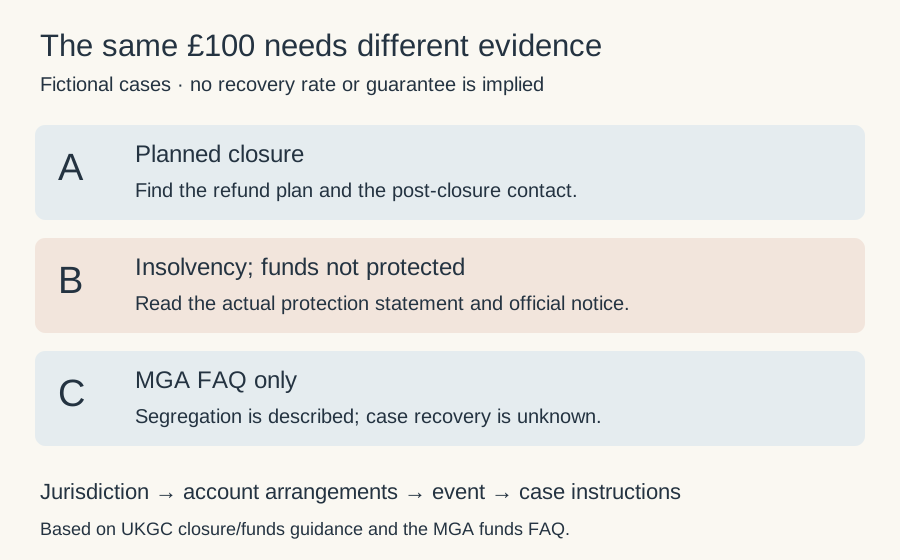
Case A is a fictional planned closure with a £100 customer balance and an identified refund contact. The immediate question is how the operator proposes to return the money, including after the main website shuts. A solvent closure notice is not evidence that the £100 must pass through an insolvency process.
Keep the closure instructions with the account statement.
Case B has the same fictional balance but an insolvency notice and terms describing funds as not protected. Now the protection statement is central. The Commission's public explanation warns that money in this position forms part of the business's assets and is likely to be lost.
Do not borrow Case A's refund timetable and present it as Case B's recovery deadline.
Case C has a Malta-regulated account, a £100 balance and only the general player-funds FAQ available. The FAQ supports recording a segregation requirement, but the case-specific recovery mechanism remains unknown. The next missing evidence is the operator's actual arrangements and the official instructions for that closure or failure.
The figure marks that gap explicitly; it does not fill it with an invented percentage.
These cases are a comparison of questions, not a ranking of operators or countries. Holding the amount constant makes the effect of the documentary situation easier to see. It also prevents the diagram from suggesting that a smaller balance receives different legal treatment simply because the illustration uses a different number.
Sources: Money and rights; How are player funds protected?; Closing a Gambling Commission licensed gambling business.
The same £100 in three evidence situations
| Case | Situation | Evidence in hand | The next question | Evidence |
|---|---|---|---|---|
| Case A | Fictional planned closure, £100 balance | An identified refund contact and the closure instructions | How the operator proposes to return the money, including after the main website shuts | · Closing a Gambling Commission licensed gambling business |
| Case B | Insolvency notice, £100 balance | Terms describing funds as not protected | The protection statement: money in this position forms part of the business's assets and is likely to be lost | · Money and rights |
| Case C | Malta-regulated account, £100 balance | Only the general player-funds FAQ | The operator's actual arrangements and the official instructions for that closure or failure | · How are player funds protected? |
Holding the amount constant makes the effect of the documentary situation easier to see.
Preserve the claim without promising its outcome
Retain the account statement, closure messages, applicable terms and support correspondence in their original form. Write a separate chronology using the dates actually shown. A concise request should identify the entity, balance components and unanswered question about the repayment route.
Do not send passwords or unredacted financial records to an address copied from an unofficial recovery message.
The regulator's public complaint route and the process for an insolvent company's creditors may serve different purposes. The documents checked here do not establish a single procedure that supersedes every administrator's or court's instructions. Follow the official notice for the specific entity and keep any uncertainty visible when seeking clarification.
The jurisdiction determines which framework is relevant; it does not, on its own, calculate a payout. A useful comparison stops at the point where general guidance ends and case evidence begins. For these sources, that means distinguishing closure from failure, identifying the customer funds and reading the protection arrangement without turning it into a guarantee.
Sources: Lodge a Complaint; What happens to your money if a gambling business goes bust.
How to preserve the claim
A method for keeping the evidence usable, not a promise about the outcome.
Retain the originals
Keep the account statement, closure messages, applicable terms and support correspondence in their original form.
Write a separate chronology
Use the dates actually shown: notice date, final gambling date, main-site closure date and refund-contact deadline.
Draft one concise request
Identify the entity, the balance components and the unanswered question about the repayment route.
Send nothing sensitive to an unofficial address
Do not send passwords or unredacted financial records to an address copied from an unofficial recovery message.
Follow the official notice for the entity
The regulator's complaint route and an insolvent company's creditor process may serve different purposes; keep any uncertainty visible when seeking clarification.
What the result means
You have distinguished closure from failure, identified the customer funds and read the protection arrangement without turning it into a guarantee. The case evidence, not the jurisdiction, calculates the payout.
Terms in the log
- Planned closure
- A business withdrawing from a market while still able to pay its debts; it calls for an orderly return of funds.
- Insolvency
- A business unable to pay its debts; the legal protection of customer funds then decides what happens to a balance.
- Customer funds
- Deposits, winnings owed and earned bonus entitlements, as the Commission defines them; stakes on open bets are excluded.
- Segregation
- Keeping customer money in a separate account; it does not by itself guarantee repayment on failure.
- Settlement
- The record showing a bet or offer has been resolved, so an amount can be treated as owed rather than pending.
Questions answered
What happens to my balance if an offshore casino closes?
First identify the contracting entity, applicable framework and whether the event is a planned closure or insolvency. A foreign address alone does not determine the answer, and the documents reviewed here cannot promise a recovery amount.
Does a separate player-funds account guarantee repayment?
No universal guarantee follows from the word separate. The Commission expressly warns that segregation does not ensure recovery in insolvency; the MGA FAQ checked here describes segregation without providing a universal payout guarantee.
Is all money shown on my account treated as customer funds?
The Commission's definition includes deposits, winnings owed and earned bonus entitlements, but excludes stakes on open bets. An unearned promotional amount should not be added to a claim without checking its status and terms.
How much notice should a British-licensed casino give before closing?
The Commission's closure guidance considers two weeks a minimum and four weeks preferable, with circumstances acknowledged. This is closure guidance, not a guaranteed withdrawal or insolvency-payment timetable.
Can I take a complaint to the Malta Gaming Authority?
Its complaint service covers the relevant services of MGA licensees and directs players to approach the operator first. Establish that the account belongs within that scope; a logo or overseas address is not enough.
Are gambling balances protected like a bank account?
No. The Commission warns that gambling balances are not protected by it or the government in the same way as personal bank accounts, and that a separate account does not guarantee recovery if the business fails.
Market sources
Continue reading
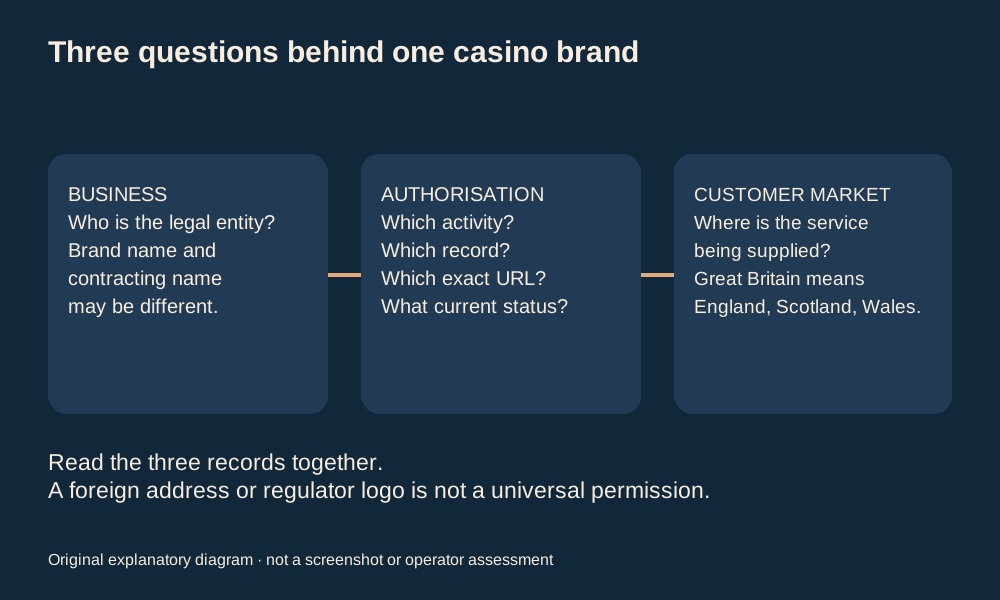
Where is an online casino based — and why does it matter?
A map of brand, legal entity and customer market explains why an overseas address or regulator logo cannot answer every licensing question.
Read Where is an online casino based — and why does it matter?
Grand Lisboa: a casino in the shape of a landmark
A 40-storey lotus tower over a podium that holds the casino. Two first-party sources describe it, and neither of them changes what a UK player is owed.
Read Grand Lisboa: a casino in the shape of a landmark
Baden-Baden’s casino and the conversation house
The Kurhaus places casino rooms inside a longer history of strolling, music and social exchange.
Read Baden-Baden’s casino and the conversation house
Inside the Casino de Monte-Carlo’s theatrical history
The Salle Garnier places performance at the heart of a familiar casino-city image.
Read Inside the Casino de Monte-Carlo’s theatrical history
A casino regulator and a dispute adjudicator have different jobs
Map an account complaint across Great Britain and Malta by separating the operator, the adjudicator and the regulator, with a fictional two-issue case.
Read A casino regulator and a dispute adjudicator have different jobs
How does a UKGC licence protect players?: what it means for a UK player, regulator by regulator
The protections a Great Britain licence gives a player are written in the Licence Conditions and Codes of Practice: an eight-week complaints clock, a free dispute body, a stated level of protection for deposited money and a self-exclusion register. This log lists each one against the regulator's own page, and states what a UK reader is left with when the account sits outside that regime.
Read How does a UKGC licence protect players?: what it means for a UK player, regulator by regulator
Continue reading
Where is an online casino based — and why does it matter?
A map of brand, legal entity and customer market explains why an overseas address or regulator logo cannot answer every licensing question.
Read Where is an online casino based — and why does it matter?How does a UKGC licence protect players?: what it means for a UK player, regulator by regulator
The protections a Great Britain licence gives a player are written in the Licence Conditions and Codes of Practice: an eight-week complaints clock, a free dispute body, a stated level of protection for deposited money and a self-exclusion register. This log lists each one against the regulator's own page, and states what a UK reader is left with when the account sits outside that regime.
Read How does a UKGC licence protect players?: what it means for a UK player, regulator by regulatorA casino regulator and a dispute adjudicator have different jobs
Map an account complaint across Great Britain and Malta by separating the operator, the adjudicator and the regulator, with a fictional two-issue case.
Read A casino regulator and a dispute adjudicator have different jobsGrand Lisboa: a casino in the shape of a landmark
Baden-Baden’s casino and the conversation house
Inside the Casino de Monte-Carlo’s theatrical history
A casino regulator and a dispute adjudicator have different jobs
How does a UKGC licence protect players?: what it means for a UK player, regulator by regulator