Jurisdiction guide
What a Curaçao licence means for a UK player: complaints, balances and whether the site may serve you at all
Three regulators publish three different promises. This page puts the Gambling Commission, the Malta Gaming Authority and the Curaçao Gaming Authority side by side on complaints, dispute bodies, player funds and advertising, quoting each regulator's own page as it read on 18 September 2026, and it starts with the British rule that decides whether a site may take a player in Great Britain at all.
One rule sits above every logo in the footer
The Gambling Commission's page on illegal gambling, dated 18 September 2025, opens with the rule that governs everything else on this page: "It is illegal to provide gambling facilities to consumers in Great Britain without: an operating licence from the Gambling Commission" or "a valid exemption for non-commercial gambling". The next sentence closes the gap a footer logo invites: "This applies regardless of where in the world the gambling is provided from."
The Commission's remote-sector guidance says the same thing to operators: "You need a licence from us if you provide facilities for remote gambling to consumers in Great Britain." Its worked example is this page's case. "You must have a licence to serve British consumers. For example, if your business is based in Malta, but your betting website or app can be played by people in England, Scotland or Wales." Swap Malta for Curaçao and the sentence reads the same.
The statute behind it is section 33 of the Gambling Act 2005, which makes providing facilities for gambling an offence unless the provider holds an operating licence authorising the activity. Section 36(3) extends section 33 to remote gambling where "no such equipment is situated in Great Britain but the facilities are used there", and section 36(3A) adds a knowledge test: the provider offends "only if the person knows or should know that the facilities are being used, or are likely to be used, in Great Britain". On summary conviction the maximum is "imprisonment for a term not exceeding 51 weeks, a fine not exceeding level 5 on the standard scale, or both", with six months' imprisonment in Scotland.
So the question in the search box splits in two. Whether a Curaçao-licensed site may lawfully take your custom is answered by British law, and the answer is no unless the same operator also holds a Commission licence covering that site. What the Curaçao licence obliges the operator to do for you is answered by Curaçao's ordinance and regulator, and those are the pages the rest of this article reads.
"Great Britain" here means England, Scotland and Wales; Northern Ireland has its own framework, which this page does not analyse. The headline says "UK player" because that is how the question is searched. The method is the one used across Night Atlas: on 18 September 2026 we fetched each regulator's own pages and the legislation behind them, quoted wording where wording matters, and recorded where a page is silent. No operator was assessed and no account was opened.
Sources: Gambling Commission: How we tackle illegal gambling; Gambling Commission: Remote sector guidance; Gambling Act 2005, section 33; Gambling Act 2005, section 36.
The Curaçao Gaming Authority, in its own words
The Curaçao Gaming Authority answers the most-searched question about itself on its About page. It "is a foundation, incorporated on April 19, 1999, with the specific purpose of becoming the regulator for the entire gaming industry operating in and from Curaçao", and it "was mandated by the Minister of Finance to carry out the licensing and supervision of the Curaçao online gaming sector".
The law it now works under is the Landsverordening op de kansspelen, the National Ordinance on Games of Chance, known as the LOK. The CGA's online gaming page states: "As of December 24, 2024, the new Landsverordening op de kansspelen (LOK) has officially come into effect". One sentence on its About page gives the same day with the year 2025 while another sentence on the same page says 24 December 2024; the ordinance PDF the CGA links carries 30 December 2024 in its file name. We treat 24 December 2024 as the date and record the discrepancy rather than smooth it over.
The online gaming licence registry is a PDF, dated 16 September 2026 when linked on 18 September 2026, under a caveat worth quoting in full: "These overviews do not guarantee the current validity of the licenses, as the licensing status of the entities may vary over time." A licence found in a PDF is a statement about the date of the PDF.
The sentence that matters most to a player sits under the "Complaints" heading of the online gaming page. "We would like to clarify that the CGA does not handle individual complaints against gaming providers. Resolving disputes between players and gaming operators is not within our mandate." It continues: "The CGA is not a civil court and cannot order gaming operators to compensate players or issue judgments" and "We do not have the authority to mediate or arbitrate in these matters."
The same passage says what a complaint to the CGA does achieve: "If a complaint or a pattern of complaints indicates a possible violation of the law, we may take appropriate action against the operator." Complaints go to an email address, with "a standardized claim form" promised to feed "our risk-based supervisory approach". A complaint to Curaçao is intelligence for a supervisor, not a claim before an adjudicator. That is the plainest answer to "Curaçao licence versus UKGC": the Commission licenses the British market and binds its licensees to a dispute body; the CGA licenses operation "within or from Curaçao" and declines the dispute role.
Sources: Curaçao Gaming Authority: About us; Curaçao Gaming Authority: Online gaming; Curaçao Gaming Authority: Licence register.
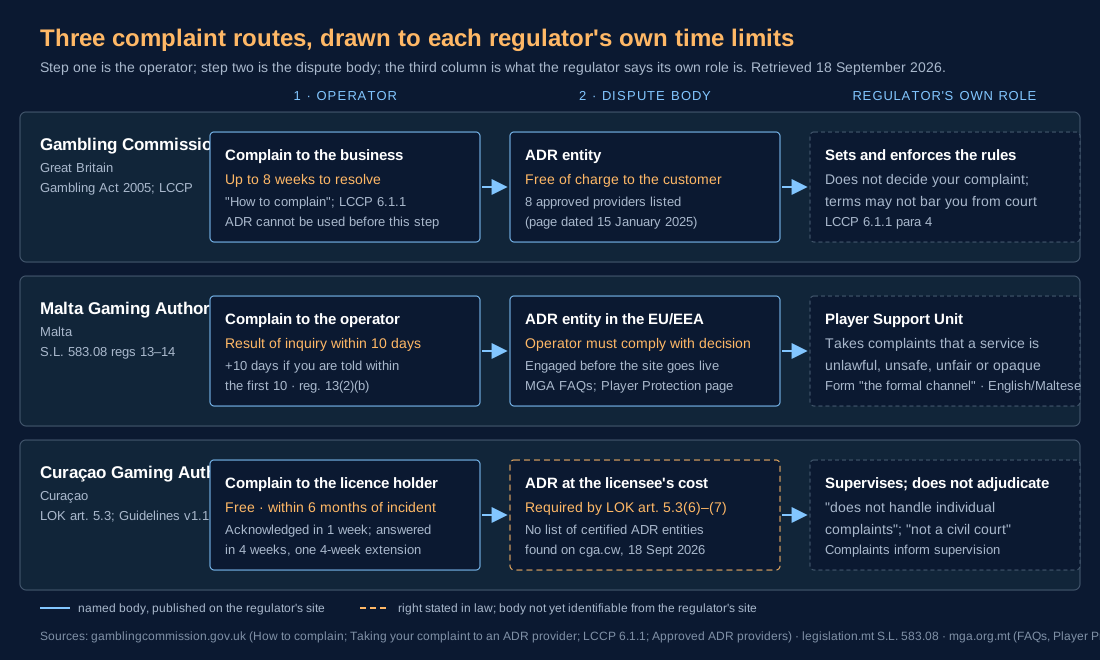
Three complaint routes, each with its own clock
For a Commission licensee the route is published for consumers in plain terms. "First of all you should complain directly to the gambling business." Then: "The gambling business has 8 weeks to resolve your complaint from when they receive it." After that "you can take your complaint to an ADR provider", described as "a free, independent service", and not before: "You cannot take your complaint to an ADR without first going through the gambling business's complaint process."
The operator's side is licence condition 6.1.1: arrangements for customers "to be able to refer any dispute to an ADR entity in a timely manner if not resolved to the customer's satisfaction by use of their complaints procedure within eight weeks of receiving the complaint", with the ADR service "free of charge to the customer". Paragraph 4 forbids terms that "restrict, or purport to restrict, the customer's right to bring proceedings against the licensee in any court of competent jurisdiction". The Commission's approved-providers page, last updated 15 January 2025, lists eight ADR entities and says "Licensed operators are required only to use one or more ADR entity which has been approved by us."
One wrinkle stays visible. Condition 6.1.1 now defines an ADR entity as a person "granted accreditation by the Secretary of State" under the Digital Markets, Competition and Consumers Act 2024, while the approved-providers page still calls the Commission "the designated competent authority for gambling". Which wording governed on a given date is not established here.
Malta writes the operator's clock into subsidiary legislation. Regulation 13(2) of the Gaming Player Protection Regulations (S.L. 583.08) requires an operator, on receipt of a complaint, to "immediately inquire into the complaint" and to "inform the complainant of the results of such inquiry within ten days from the date on which the complaint is received". The period "may be extended by a further ten days" if the player is told within the first ten. Regulation 14 then lets the player "refer any dispute arising therefrom to an ADR entity", "without prejudice to the player's right to lodge a complaint" with the MGA's Player Support Unit.
The MGA's FAQs fix the ADR side: the entity is engaged "prior to going live with operations", must be "established within the European Union or the European Economic Area", and "Operators are required to fully comply with any decision given by their Alternative Dispute Resolution (ADR) entity." The MGA's own form is "the formal channel enabling players to lodge a complaint against MGA-licensed operators"; that page, updated 19 August 2026, reviews cases "in English or Maltese" and reported "intermittent technical issues affecting its online complaint form" with an email fallback.
Curaçao's ordinance gives the player a right against the licence holder. Article 5.3(1) of the LOK, in our translation from the Dutch text the CGA publishes with the note that it is "not in the official format", says a participant may, within six months of an incident, complain free of charge to the licence holder. Article 5.3(6) requires the licence holder to offer "at all times" the possibility of alternative dispute resolution, and article 5.3(7) puts that at the licence holder's cost.
The CGA's Player Complaints Policy Guidelines, version 1.1 of 18 June 2025, turn the right into deadlines; "Adherence to this Complaints Policy is considered a requirement under the LOK". The operator must "Confirm receipt of the complaint in writing" within one week and "will assess and respond to complaints within four weeks", extendable once by four; responsible-gambling complaints get two days and five business days. On ADR: "Each licensed operator must offer independent ADR services", and "Operators must have uploaded to the CGA Portal an agreement with at least one CGA Certified ADR entity, within one month of the publication of the Certified ADR Providers on the official website."
That clause is where the route runs out of visible road. On 18 September 2026 we could not find a published list of certified ADR providers on cga.cw, in its publications index or in its Q2 2026 stakeholder bulletin. The guidelines also let operators set "ADR parameters", including "a minimum claim value required for escalation to ADR", and restate the CGA's position: "The CGA will not resolve or make decisions on any player complaints regarding gambling-related transactions on the operator's website(s)." The right exists on paper; the body that would hear it could not be named from the regulator's site.
Sources: Gambling Commission: How to complain; Gambling Commission: Taking your complaint to an ADR provider; LCCP 6.1.1; Approved ADR providers; Gaming Player Protection Regulations, S.L. 583.08; MGA FAQ: engaging an ADR entity; MGA FAQ: complying with ADR decisions; MGA: Lodge a complaint; LOK (Dutch text); CGA Player Complaints Policy Guidelines v1.1.
Where your balance sits if the company fails
The Commission's requirement has two parts. Segregation under licence condition 4.1.1 applies, in the Commission's own summary, to "Remote gambling operators except B2B and ancillary remote bingo or ancillary remote casino licences". Disclosure under condition 4.2.1 obliges any licensee holding customer funds to say whether funds are protected in an insolvency, at what level and how, and to have the customer acknowledge that in writing before the funds can be used, at first deposit and after any change.
The level is one of the Commission's published ratings. "Not protected – segregation of customer funds" means the money is "kept in accounts separate from business accounts but they would form part of the assets of the business in the event of insolvency", and the Commission says such arrangements "provide no protection in the event of insolvency". "Medium protection" means "arrangements have been made to ensure assets in the customer accounts are distributed to customers in the event of insolvency", though "there is no absolute guarantee". "High protection" means "a formal trust account which is legally and in practice separate from the affairs of the company", verified by "an independent trustee or external auditor". Segregation, in Britain, is a floor and not a promise; the promise is whichever rating the operator has chosen and disclosed.
Malta puts the promise in the regulation itself. Regulation 7(1) of S.L. 583.08: "An authorised person shall segregate player funds at all times from the funds of any other person", with a common player-funds account permitted. Regulation 6(1), headed "Player funds protected from operator's creditors", provides that "the creditors of an authorised person shall have no claim or right of action on or against the player funds held by the authorised person" and that players' claims "shall constitute a privileged claim, and shall be paid in preference to all other claims".
The LOK handles the same question as a power rather than a duty. Article 5.8 says the CGA may ("kan") attach conditions to a licence which may among other things relate to, at sub (g), "the segregation and reservation of player balances or the insurance of those balances, and the payment of the balances to players" (our translation). Whether a given licence carries that condition is not something the ordinance states, and the CGA's site published no standard licence conditions on 18 September 2026.
Article 5.7 adds a mechanism with no counterpart in Britain or Malta: a guarantee fund ("waarborgfonds") that licence holders must join against payment of a premium, "to insure the payout of player balances to participants in remote games of chance". Its manager, premiums and further rules are left to decree. Nothing on the CGA's site on 18 September 2026 showed the fund operating, what it pays, or to whom. Treat it as a provision in law whose working status is unestablished.
Sources: Gambling Commission: Summary of all customer funds requirements; LCCP 4.2.1; The customer funds insolvency ratings system; S.L. 583.08; MGA FAQ: How are player funds protected?; LOK (Dutch text).
Who may put the offer in front of you
Advertising is the second place British law reaches an overseas operator. Section 330(1) of the Gambling Act 2005: "A person commits an offence if he advertises unlawful gambling." Section 333(2) applies that prohibition to advertising "by way of remote communication" where, under subsection (4)(a), it involves "providing information, by whatever means (and whether or not using remote communication), intended to come to the attention of one or more persons in Great Britain".
For licensees, condition 5.1.6 requires compliance with "the advertising codes of practice issued by the Committee of Advertising Practice (CAP) and the Broadcast Committee of Advertising Practice (BCAP) as applicable" and marketing "in a socially responsible manner". The Commission's action against everyone else is counted on its own blog. In a post of 21 October 2024 its chief executive reported, since April 2024, "259 cease-and-desists issued to operators and 189 to advertisers", referral of "over 78,000 URLs to Google with 50,000 of these removed", and "255 websites taken down". Those are the Commission's figures on that date, not a current tally.
The MGA's rule for its licensees is the Gaming Commercial Communications Regulations. Its FAQ: "Adverts must be compliant with the requirements envisaged in the Gaming Commercial Communications Regulations (S.L. 583.09), including but not limited to, displaying the licensee's name, licence number, the minimum age to participate and responsible gaming-related information", and "Adverts displayed on social media must also be compliant with the Regulations". None of that alters the British position: an advert aimed at Great Britain for a site without a Commission licence is the offence in section 330 whatever Maltese rules it satisfies.
The LOK sets three principles in article 5.6(1). A licence holder must ensure that its marketing and advertising activities, "including the offering of bonuses", do not incite excessive participation, are not misleading and are not aimed at vulnerable persons (our translation of "niet aanzetten tot onmatige deelname", "niet misleidend zijn", "niet gericht zijn op kwetsbare personen"). Detailed rules are left to decree, and none appeared among the CGA's publications on 18 September 2026; the three principles are, for now, the published rule.
Sources: Gambling Act 2005, section 330; Gambling Act 2005, section 333; LCCP 5.1.6; Gambling Commission blog: Our approach to tackling unlicensed gambling; MGA FAQ: What is required when advertising?; Curaçao Gaming Authority: Publications.
The side-by-side, cell by cell
The table below is the artefact this page was written to hold. Each cell states what the regulator's own page or the underlying legislation says and links to it; every link was fetched on 18 September 2026. Where a cell says "not found", that records a search of the regulator's site that turned up nothing, not a finding that no rule exists. Quotations from the LOK are our translation of the CGA's Dutch text.
| Question | Gambling Commission (Great Britain) | Malta Gaming Authority | Curaçao Gaming Authority |
|---|---|---|---|
| May the operator take a player in Great Britain on this licence alone? | Yes; the operating licence is the permission. "You need a licence from us if you provide facilities for remote gambling to consumers in Great Britain." Source: Remote sector guidance, retrieved 18 September 2026. | No. The requirement "applies regardless of where in the world the gambling is provided from", and the Commission's own example is a Malta-based site "played by people in England, Scotland or Wales". The MGA pages fetched make no claim to cover Great Britain. Source: How we tackle illegal gambling; Remote sector guidance, retrieved 18 September 2026. | No, for the same reason. The CGA describes its remit as gaming "conducted within or from Curaçao". Source: How we tackle illegal gambling; CGA: Online gaming, retrieved 18 September 2026. |
| Where does a complaint go first, and how long does the operator have? | To the business. "The gambling business has 8 weeks to resolve your complaint from when they receive it." Source: How to complain; LCCP 6.1.1, retrieved 18 September 2026. | To the operator, which must "immediately inquire into the complaint" and report the results "within ten days from the date on which the complaint is received", extendable by a further ten days with notice in the first ten. Source: S.L. 583.08, regulation 13(2), retrieved 18 September 2026. | To the licence holder, free of charge, within six months of the incident (LOK art. 5.3(1)). Receipt confirmed "Within one week"; response "within four weeks", one four-week extension. Source: LOK art. 5.3; Player Complaints Policy Guidelines v1.1, retrieved 18 September 2026. |
| Who decides a dispute the operator will not settle? | An ADR entity, "free of charge to the customer"; the Commission lists eight approved providers on a page dated 15 January 2025. Terms may not restrict the right to go to court. The Commission does not decide individual complaints. Source: LCCP 6.1.1; Approved ADR providers; Taking your complaint to an ADR provider, retrieved 18 September 2026. | An ADR entity "established within the European Union or the European Economic Area", engaged "prior to going live"; "Operators are required to fully comply with any decision" it gives. The MGA's Player Support Unit takes complaints that a service is "unlawful, or conducted in a manner which is not safe, fair, or transparent". Source: MGA: Player Protection; MGA FAQ on ADR decisions; MGA Player Hub, retrieved 18 September 2026. | ADR must be offered "at all times" at the licence holder's cost (LOK art. 5.3(6)–(7)); an agreement with "at least one CGA Certified ADR entity" is required within a month of the CGA publishing its list. No such list found on cga.cw on 18 September 2026. The CGA "does not handle individual complaints against gaming providers" and "is not a civil court". Source: LOK art. 5.3; Guidelines v1.1; CGA: Online gaming, retrieved 18 September 2026. |
| Is the player's balance kept apart from the company's money, and what happens on insolvency? | Segregation required of remote operators (LC 4.1.1); the operator must disclose, and the customer acknowledge, a rating of "not protected", "medium" or "high" at first deposit. Segregation alone gives "no protection in the event of insolvency". Source: Summary of customer funds requirements; LCCP 4.2.1; Ratings system, retrieved 18 September 2026. | "An authorised person shall segregate player funds at all times from the funds of any other person" (reg. 7(1)); creditors "shall have no claim or right of action" on player funds and players' claims are "privileged" (reg. 6(1)). Source: S.L. 583.08, regulations 6 and 7; MGA FAQ on player funds, retrieved 18 September 2026. | The CGA "may" attach licence conditions on "the segregation and reservation of player balances or the insurance of those balances" (LOK art. 5.8(g)). A guarantee fund is provided for in art. 5.7; its operating status was not found on cga.cw. Source: LOK arts 5.7 and 5.8, retrieved 18 September 2026. |
| What rules govern advertising to the player? | Licensees must comply with the CAP and BCAP codes (LCCP 5.1.6). Advertising unlawful gambling is an offence (s.330) that reaches remote advertising "intended to come to the attention of one or more persons in Great Britain" (s.333(4)(a)). Source: LCCP 5.1.6; section 330; section 333, retrieved 18 September 2026. | Gaming Commercial Communications Regulations (S.L. 583.09): adverts must display "the licensee's name, licence number, the minimum age to participate and responsible gaming-related information"; social media included. Does not make an advert lawful in Great Britain. Source: MGA FAQ: What is required when advertising?, retrieved 18 September 2026. | LOK art. 5.6(1): marketing, "including the offering of bonuses", must not incite excessive participation, be misleading or target vulnerable persons; detail by decree, none found among CGA publications on 18 September 2026. Source: LOK art. 5.6; CGA: Publications, retrieved 18 September 2026. |
Two readings follow from the table. The first row is not a comparison at all; it is British law applied to three logos, and it reads the same for Malta and Curaçao. Rows two to five are comparisons, and the pattern is consistent: the Commission and the MGA name the body that hears a dispute and bind the operator to it; the CGA names a right, prices it at the operator's cost, and leaves the body unnamed on its own site.
Which regulator covers your account, and what each licence carries
An account is governed by the licence that covers that website and that legal entity, not by the brand. A Commission licensee must "display that they are licensed and also provide a link to our public register", and the register "allows you to see what type of activities gambling businesses can offer, and if we have ever taken any regulatory action against them". The MGA's register can be searched "by licensee name, authorisation status, URL or Gaming Service", and its Unauthorised URLs page, updated 16 September 2026, lists addresses with which the authority "has no connection" and whose references to an MGA licence are "false and misleading". The CGA's register is the dated PDF described above. The step-by-step procedure for checking any of them is Licence Lens's subject; this page stops at what a match means once found.
Whether an offshore casino is legal in Great Britain is a question about the operator: section 33 makes the provider the offender, and the Commission's enforcement is aimed at operators, advertisers, search results and payment providers. None of the pages fetched for this article states that a player commits an offence by using an unlicensed site, and none states that such a player has any protection under British rules. Both silences should be read literally.
What a Commission licence carries, for a person in Great Britain, is the set of obligations above plus one that Play in Balance covers in full: social responsibility code 3.5.5, under which remote licensees "must participate in the national multi-operator self-exclusion scheme". On a Curaçao-licensed site the protections are the LOK's, enforceable through the operator's complaints procedure, an ADR entity or a court; the CGA has said it will not adjudicate. On a Malta-licensed site the protections are Malta's regulations, with an ADR entity the operator must obey and a Player Support Unit that takes reports. In neither case does the Commission have a role, and in neither case do the eight-week clock, the disclosed funds rating or the national self-exclusion scheme apply.
Sources: Gambling Commission: Make sure that the gambling business is licensed; Gambling Commission: Public register; MGA: Licensee register; MGA: Unauthorised URLs; LCCP 3.5.5.
Contracts, debts and what this page leaves open
Section 335(1) of the Gambling Act 2005 answers the oldest question in the territory: "The fact that a contract relates to gambling shall not prevent its enforcement." Subsection (2) preserves "any rule of law preventing the enforcement of a contract on the grounds of unlawfulness (other than a rule relating specifically to gambling)", and the section extends to England, Wales and Scotland. Whether a particular contract with an operator that has no Commission licence falls inside that reservation is a question for a court on its facts; this page records the section and stops.
Four things stay open, listed so a reader can check whether they have closed. First, no list of CGA-certified ADR entities was found on the CGA's website on 18 September 2026, so the Curaçao ADR route could not be traced to a named body. Second, the LOK's guarantee fund exists in article 5.7, but its operation, manager and cover could not be established from the regulator's site. Third, the CGA's About page gives the LOK's entry into force as 24 December in both 2024 and 2025 in different sentences; its online gaming page says 2024. Fourth, the Commission's two pages on ADR describe accreditation differently, and the date on which the 2024 Act's regime took over is not established here.
To repeat the exercise, take the source list at the foot of the page, fetch each address, and compare the quoted wording against the live text. The pages change, the retrieval date is the claim, and a difference between what is quoted here and what a page now says is itself a finding worth recording.
Sources: Gambling Act 2005, section 335.
Market sources
- How we tackle illegal gambling, Gambling Commission, retrieved 18 September 2026.
- Remote sector guidance, Gambling Commission, retrieved 18 September 2026.
- How to complain, Gambling Commission, retrieved 18 September 2026.
- Taking your complaint to an Alternative Dispute Resolution (ADR) provider, Gambling Commission, retrieved 18 September 2026.
- LCCP condition 6.1.1: Complaints and disputes, Gambling Commission, retrieved 18 September 2026.
- Approved Alternative Dispute Resolution (ADR) providers, Gambling Commission, retrieved 18 September 2026.
- LCCP condition 4.2.1: Disclosure to customers, Gambling Commission, retrieved 18 September 2026.
- Customer funds: summary of all customer funds requirements, Gambling Commission, retrieved 18 September 2026.
- Customer funds: the customer funds insolvency ratings system, Gambling Commission, retrieved 18 September 2026.
- LCCP condition 5.1.6: Compliance with advertising codes, Gambling Commission, retrieved 18 September 2026.
- LCCP code 3.5.5: Remote multi-operator self-exclusion, Gambling Commission, retrieved 18 September 2026.
- Make sure that the gambling business is licensed, Gambling Commission, retrieved 18 September 2026.
- Public registers and datasets, Gambling Commission, retrieved 18 September 2026.
- Unlicensed gambling: our approach to tackling unlicensed gambling (21 October 2024), Gambling Commission, retrieved 18 September 2026.
- Gambling Act 2005, section 33, legislation.gov.uk, retrieved 18 September 2026.
- Gambling Act 2005, section 36, legislation.gov.uk, retrieved 18 September 2026.
- Gambling Act 2005, section 330, legislation.gov.uk, retrieved 18 September 2026.
- Gambling Act 2005, section 333, legislation.gov.uk, retrieved 18 September 2026.
- Gambling Act 2005, section 335, legislation.gov.uk, retrieved 18 September 2026.
- Player Hub, Malta Gaming Authority, retrieved 18 September 2026.
- Lodge a complaint, Malta Gaming Authority, retrieved 18 September 2026.
- FAQ: Do operators have to engage an ADR entity?, Malta Gaming Authority, retrieved 18 September 2026.
- FAQ: Do operators have to comply with ADR decisions?, Malta Gaming Authority, retrieved 18 September 2026.
- Player Protection, Malta Gaming Authority, retrieved 18 September 2026.
- FAQ: How are player funds protected?, Malta Gaming Authority, retrieved 18 September 2026.
- Gaming Player Protection Regulations, S.L. 583.08, Government of Malta (legislation.mt), retrieved 18 September 2026.
- FAQ: What is required when advertising?, Malta Gaming Authority, retrieved 18 September 2026.
- Licensee register, Malta Gaming Authority, retrieved 18 September 2026.
- Unauthorised URLs, Malta Gaming Authority, retrieved 18 September 2026.
- About us, Curaçao Gaming Authority, retrieved 18 September 2026.
- Online gaming, Curaçao Gaming Authority, retrieved 18 September 2026.
- Online gaming legislation, Curaçao Gaming Authority, retrieved 18 September 2026.
- Landsverordening op de kansspelen (LOK), Dutch text, Curaçao Gaming Authority, retrieved 18 September 2026.
- Player Complaints Policy Guidelines, version 1.1 (18 June 2025), Curaçao Gaming Authority, retrieved 18 September 2026.
- Licence register, Curaçao Gaming Authority, retrieved 18 September 2026.
- Publications, Curaçao Gaming Authority, retrieved 18 September 2026.